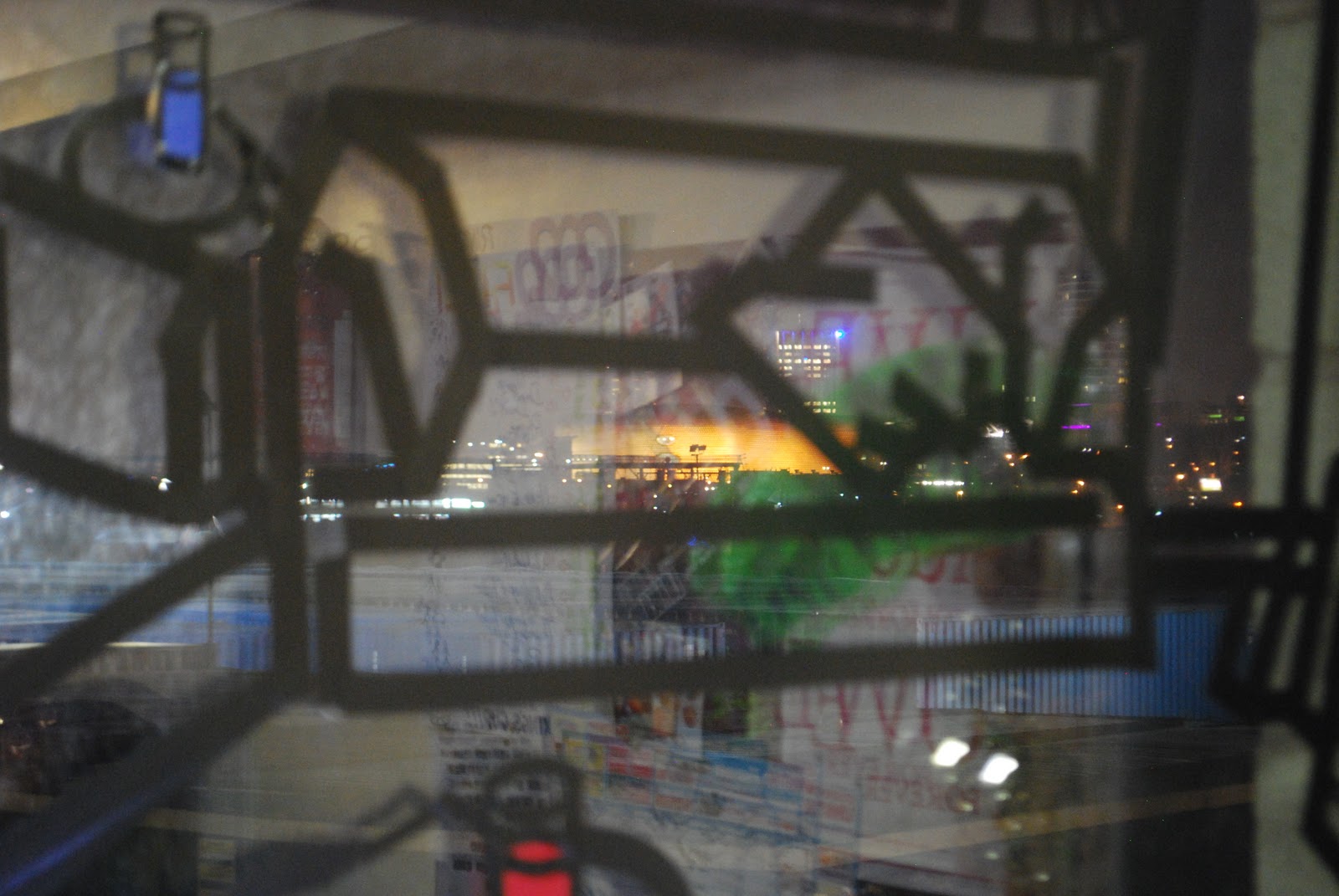
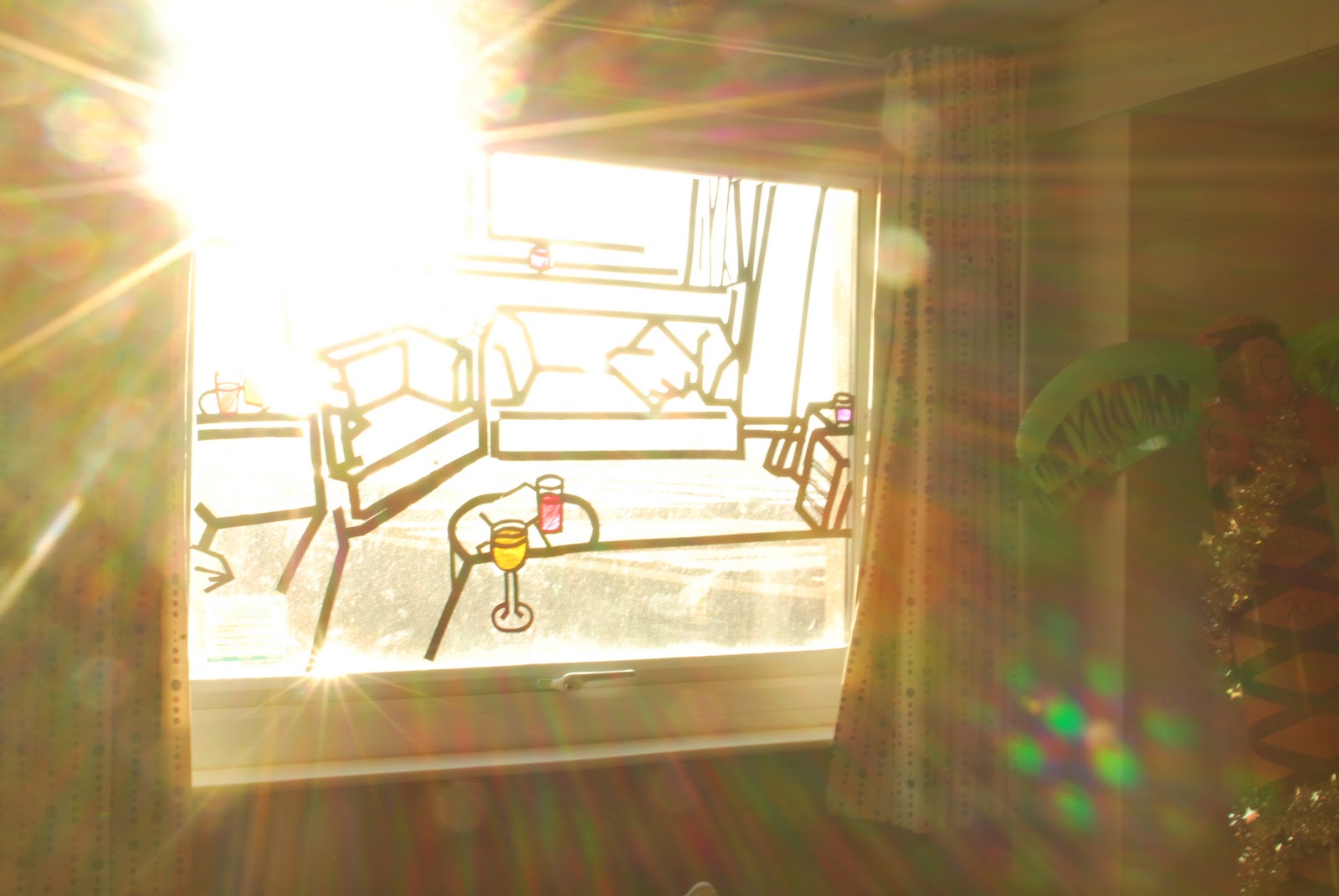
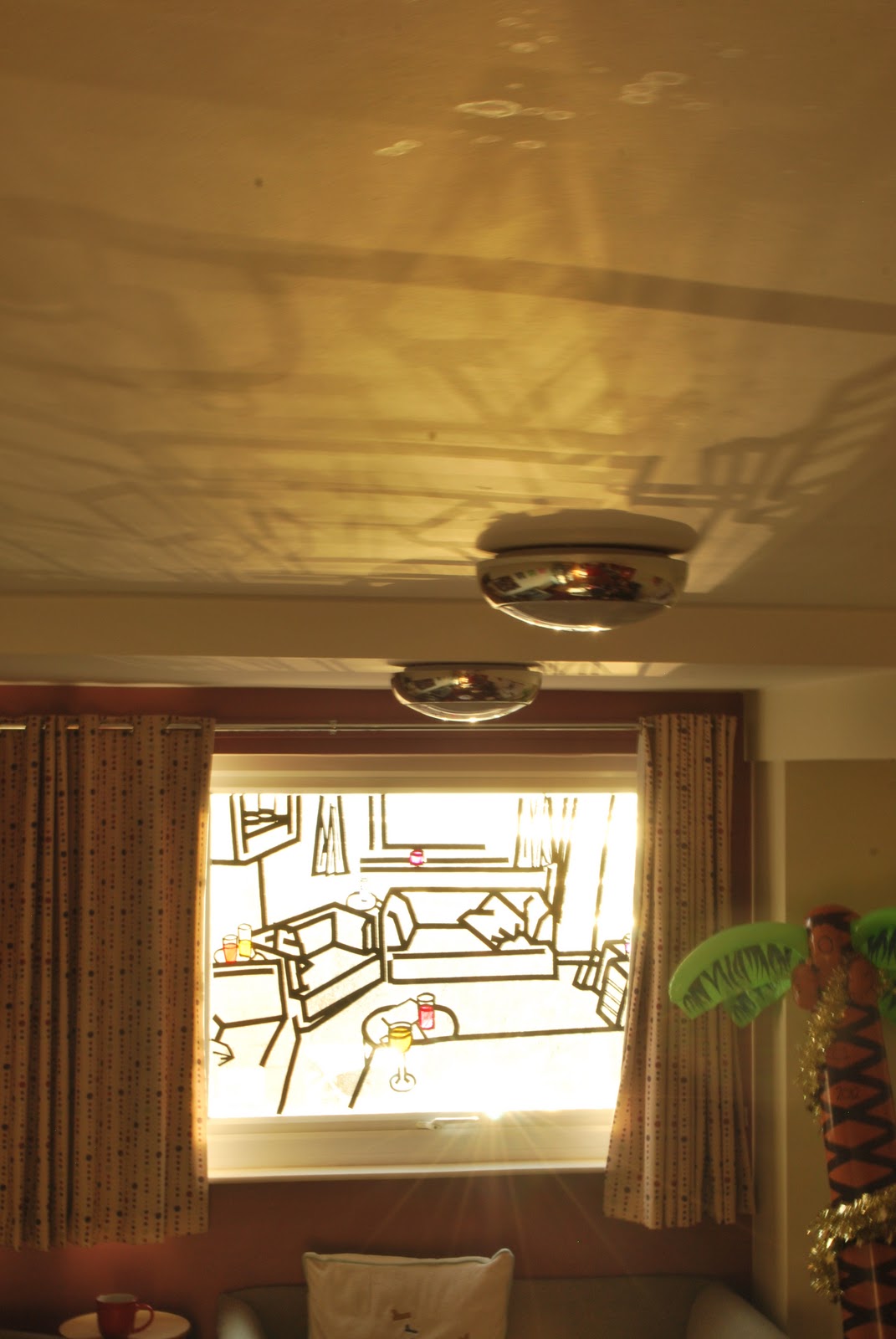
So following on from my tutorial I made a stain glass window in my living room using black insulation tape and painted acetate for the coloured glasses. I took images of the window at different times of the day to see when it would look it's best:
When the light indoors was turned on the tape would be doubled by the reflection on the glass.
When the light is shining behind the window the image is at it's clearest, but when it is extra bright you can't see what is outside the window. However during different times of the day when the sun was at it's strongest the picture would be projected onto the wall, moving from opposite in the kitchen, around the room and onto the ceiling.
When one of my flatmates walked past the projection I liked the interruption it created, moving the image onto his back and distorting the overall picture.
When I stood in front of the window my shadow blocked the projection but left my silhouette in the middle, making me part of the image.
I took photos of the window from different places in the flat to trying to include other items and details unlike the pristine images placed in the window, below shows the sink, cooking utensils and work surfaces but you can;t see outside the window, where as the next one includes daily left items around the living room space and shows you the same view from the window as my film.
The last time I had feedback on my practical work from my tutor group I was working on the filming of trains in the view from my window. Since then my work has moved on quite a bit and change direction, so I wanted to show this to my group to see what they though of it and to explain how I've got to this point.
I printed off examples of my work so far to show the development from photos that have been edited, to traced outlines, one of which I chose to be enlarged and split onto frames for the group exhibition. I also included the edits of my sketches that started of the Michael Craig-Martin inspired style.
Considering the majority of the group didn't get to see my films (due to the tutorial being half my tutor group and half of another's) and that they didn't know what the idea behind this work was I was pleased with the initial response some of the group suggested. One said that the scenes with the glasses made them think that it had been placed by someone, that there could have been somewhere there and this is what was left behind. As a scene this is the feeling I wanted to create, the idea of there being a presence, someone having previously being there. Unlike the series of photographs that I took in the past where you could see the difference between each shot, the group felt that the glasses looked like destination points, or a marked out route of where someone had been, which was a pretty close guess.
A point that my tutor made was that the glasses didn't excite or intrigue her, that maybe the scene would be more exciting if it showed the remains of a party or a strange night. However when asking the rest of the group it was split that this would be a scene they would recognise or feel is realistic compared to their own lives. This made us come to the conclusion that my work is very subjective, so if I did change the scene it would still only apply to the half the audience. I find the idea that this scene could be mundane quite successful as one of my intentions was to take an everyday scene and make it special by highlighting it, so if you look at the image and are led to question what it is about that image that made me chose it kind of fulfils it's purpose as you are thinking more about a scene that you would normally pass by.
My tutor felt that my most successful images were the two in the centre shown above, the one to the right being the image I chose to enlarge at the exhibition. The composition of the setting, the more detail in the scene, the angle compared to the others and the flatness of the colour, liking the hand drawn quality of the photocopied sketch tot he left. To bring the Image back to my first Idea of the view from my window I was thinking of putting it onto the same window that the trains were filmed from, making my own stain glass window.
On the 13th December my tutor group and I set up an exhibition to display one piece of work each in our studio space. After sharing some ideas as to what the exhibition could be called Charlie came up with the name 'Hybridity', finding that the word refers to a mixture that creates a single body... culturally and biologically it refers to the blurring of distinction. This definition seemed perfect for an exhibition of pieces that were more likely not going to relate to each other yet still be shown as a whole. This was our poster:
This is how we used the exhibition space:
I could have shown my film again with the improvements suggested in the group tutorial but I wanted to see try out one of my new ideas. I chose to take one of my Michael Craig-Martin inspired pieces. I wanted to continue with the idea of making an everyday situation more special by adding techniques that would be easily recognisable, for example making something larger would suggest it had more importance than something on a smaller scale. I chose to blow up one of my edits onto a larger scale. When considering how to present this, whether to print it as a whole or in smaller pieces I thought of how the pieces could look like sections of a window frame. I split my image into eighteen A4 pieces and put them each into separate frames, the idea being that when they were put together and hung on the wall they would hopefully look like a window frame with my image being the 'stain glass window' effect.
One of my ideas was to put black tape and coloured acetate directly onto a window to make a stain glass window, but in this white cube space I think it's appropriate that the sections were printed and had white backgrounds, as though this could have been a ready made window placed onto the wall.
I chose frames in a dark wood with a gold trim as I though when put together they would look like the sort of window frame you might find in a church. This would hopefully encourage people to see the complete piece as an important symbol. I tried to get the frames as close together as possible to give more of an illusion of it being a whole. I suppose this could have been done more easily by getting an actual window frame, but this may not have been to the correct size and I also liked how it wasn't to obvious. This piece could be seen as separate parts to make a whole, I wanted the viewer to get the same feeling as they do when presented with a large image or religious symbol but for them to not perhaps know why they thought that way about it.
I like the reflections the light causes when hitting the glass, it distorts the images and makes it less visible from certain angles but also adds a quality to it as though it is a precious item, which is enhanced by the use of gold.
Looking at the work a lower angle as shown above gives it a more overwhelming effect. For the exhibition I displayed this piece at eye level to fit in with the other works in the show, however if I were to display it again it might be an idea to put it up higher like the windows you may find in a church .
Before putting up the frames I laid them out onto the floor. Some people made comments that they liked the gaps in between and the contrast between the wood floor and the white background of the pieces. Others whilst passing said it reminded them of a London Underground tube map with the black lines and occasional colour blocks. This could work well with the film of the trains and the idea travel being part of our everyday journey and existence. The final comparison was with Dexter Dalwood, as though it was a window you looking through into someone's living space.
Using my sketches and Michael Craig-Martin as inspiration I have taken more photos of my living room without anyone in it. Using the stain glass idea I've highlighted the use of the glasses in the room. One evening, every time someone left their drink on the side I put a sweet wrapper of a different colour in the glass. Conveniently the colour from the sweet wrappers spread through the drink to make a stronger colour. I've taken several different photos from different angles and then gathered all of the glasses together and took close up shots to get the best 'stained glass' effect I could. The best were the ones that where taken from an angle looking upwards as I felt like it had the same overwhelming feel you would get when looking up at an elaborate window in a church.
I wanted to highlight the colour in the images, so I edited them in Photoshop to turn everything I didn't need into black and white. These were the most successful:
I took this idea one step further by actually taking away the other elements of the photo so the only thing left was the colour from the glass. They have come out quite abstract but are still vaguely recognisable. It's almost as if a very strong light has been put behind the glasses so that they are all you can see.
Inspired by Michael Craig-Martins style I did the same to some of the photos as I did to my selected sketches. Tracing over the original photo in Photoshop I used simple outlines of all the shapes to create the images below. I purposefully didn't include the christmas tree and other details as I didn't want it to be seasonal or to have a significance to a special occasion seeing as the point is to show it on a 'normal/non-special' day. Selecting the same colour as what was shown in the original photos I coloured in the glasses to once again make them the focus. I like how the black lines make it look more like a stained glass window effect.
I like the idea of perhaps making these images on a larger scale and cutting out holes where there is colour, putting a translucent film of colour in it's places and hanging it to allow colour to come through. Or I could mark our these lines onto a window with black tape with coloured translucent film again.
I've taken photos of my sketched to be put into the computer. I focused on the ones that were drawn in simple lines and edited them in Photoshop to continue with the idea of these pieces looking like Michael Craig-Martins work, in the attempt to make these 'mundane' and 'everyday' scenes appear to be special or significant. Below are the examples:
After the tutorial I was recommended two things to watch; Robinson In Space which is about an impression of mundane everyday spaces and then some video footage of a Time lapse in space, sort of like a surveillance from space.
Robinson In Space by Patrick Keiller is a film about an unknown character talking about his excursions around England with his friend Robinson. Another film by Keiller is London (which I have included a clip of below). It includes the same two characters, was filmed before Robinson In Space and is based in London as the title suggests. All the film consists of is a narration by the unknown Character (voiced by Paul Scofield) talking about his reunion with his friend Robinson. The unknown character is the only one to talk in the film and you never see either of the characters. Robinson is supposedly giving the 'narrator' a tour of London and even expresses his opinions through the narrator. The footage relates to every part of the script but are never moving shots, just a camera set in a certain place relevant to each section and showing the people or objects moving about.
With the narrator and the still camera it's almost like being told a story form a book, with the film being the illustrations to help you imagine the tale. I like the idea that you never get to see the characters and how you never hear directly from Robinson, you just assume he exists because the storyteller is telling you so. Unlike my film Keiller includes the sounds taken with the footage, I feel this includes you in the image and the story, as though you're being taken on a tour around the same parts, whilst the narrator tells you the story of when he last visited there. With this soft and calming story that is personal to one person and includes their view points it bring up current opinions and issues for someone in London, for example Robinsons worry about the exploitation of the homeless, crime and expensive travel to make people long for and work for this supposedly free city life.
I have recorded audio of my living room whilst filming the trains go past the window but chose not to include it in the first showing of the film. I like how this disconnected the viewer from the film, but I like the idea of perhaps including audio still illustrate the film, showing what conversations were happening (if any) at certain times of the day and showing how life goes on around this constant image, the existence that occurs through it's duration. If I were to do this I would like to have the audio on headphones, so the piece could still be observed as silent but you could chose whether you wanted to hear the activity, almost as if you were joining in on a conversation. The intention for this would be to distract slightly from the image, you might still pay attention to it but you're focus would be on the context of the conversations, maybe to decipher if there was a connection to what was being shown. This distraction would be the same as mine in my daily life, you can day dream or have thoughts about other matters in your life (mine being going home for an example) but your day to day life activity distracts you from this, although the thought may still be in the back of your mind, like a passing train in you're window.
When searching for footage of 'time lapsing in space' I found these two films. Showing sped up films of the view from a space shuttle, there is no sound and all you can see moving on the Earth's surface, like in Grazia Toderi's La Benniale, is the twinkling of lights suggesting activity of the beings that live there. The footage is hypnotising and enticing with it colours and aesthetic appeal but also with the knowledge of where it has been shot and the fascination of seeing the world we live in from a place we are more than likely to never visit. Like in my film there is no sound, making the movement around the Earth smooth and calming, like it was suggested the silent trains in my video did. I could experiment with the idea of tempo in my footage, would speeding it up or slowing it down effect the mood or the message? would it take away too much attention or defeat the point of recording literal life in it's own time? or could it possibly add to the work?
Whilst searching for the above footage I came across this video of a lady taking a head and shoulders photo of herself everyday for four and a half years which you can view individually on her blogg. She created the film by quickly showing each photo one after the other in chronological order. Like a stop-motion film you can see the small changes on this woman's faces and appearance, that took over four years to happen, in less than a minute. This persons life flash before your eyes and although are always still and in the same position, barely changing, the film seems to move and is animated. Her living out her daily life, changing he appearance, making choices, doing the same thing more than once are all shown in this short video. In just 41 seconds you see her living yet all you are shown is a simple portrait photo of the same person in the same way everyday.
I can't help but notice the similarities between this and my own recording of my bedroom, living room and the new BIAD building everyday. Taking the shots from the same position and angle every time, just simple capturing the small changes that happen everyday. seeing them laid out you can see these changes, but if I were to make them into a film, perhaps you could physically see things appear and disappear, as though that space was alive.
My most recent tutorial was different to my others. In this on Half of my tutor group joined up with another tutors half. Instead of talking about my work I had to sit and take notes whilst the two tutor groups examined and discussed a finished piece I had presented. In this example I chose to show My film of the view from my living room window. I presented it on 3 TVs (unfortunately they couldn't be identical so the 3rd was slightly different), each showing a twenty four minute clip of my footage from different times of the day. For fifteen minutes the group talked about my work, what they got from, what they thought it meant and how they thought I could take it further.
Below are my notes from the tutorial:
Transport - environment
Times of day - morning/day/evening
Moods - Light and dark changing in relation to changing moods
An internet recording?
Time and space
Time
CCTV footage of a train yard
Graffiti artists surveillance of an train yard for a good time to spray paint.
It's almost to simple/obvious what the meaning could be, makes me ask the question "Am I missing something?"
The variation in day and the change of the physical TV's suggests a question/comparison
"Reminds me of the impressionist" - painted the same landscape but at different times of the day.
"I'm drawn to the moving objects" - waiting for the things to move - the rest seems dead
They seem like photographs until the rare movements appear
Representing boredom - not much is happening.
Continuous - still happening now when the footage has ended
Repetition
CCTV - time and space
Watching the city
Sense of a physical distance - outside the city
Three screens - synthetic - control room.
Painterly
Compositional with the structure of the lines - George Shaw
Human activity in a city centre at a distance
Third TV - the physical shape of it is too different to the others - is there a reason?
Mundane activity.
CCTV for a graffiti artist
Impression we have of certain spaces
"Something particular about this piece"
Island of space between us and the city.
No Man's Land view - a place where you'd go to forage event though you;re not aloud to - boring yet sinister
Third screens makes it more intriguing - home surveillance - gathering of old TVs instead of manufactured new screens makes it more personal - bedroom surveillance.
The quality and focus suggest low tech - home spun - personal bedroom project
Urban life - isolated
Feels sad, alone. It belongs to them - desert Island.
No sound with the train makes it soft
TV's look like a journey - more and more abstract because of the light. Due to the days getting darker all you can see is the lights in the image, this combined with the curved glass on the third and different TV screen is what distorts the image to look abstract.
Leads from the computer could be used more in the installation - suggest home/D.I.Y. approach - add more low tech to amplify the amateur surveillance.
Use a different table to connect to home CCTV? - could include other items on the table, like fag packet or general items that could be found alongside.
Distance and no sound.
The film of the daylight is the most painterly
The lines from the boxes look almost sea-like - could look at different locations/more visual locations, places with the same aesthetic and set up whilst still providing the distance
At this point my tutor asked the question to the group what they would think of the work if instead of it being on three TV screens, it was projected on a large scale onto the wall, would this change the work for them? these were there responses:
Less personal - less intimate - remove the idea of CCTV
Completely different idea
Televisions = old - look like they been pulled from a junk yard, possible even from one of the containers in the video
Idea for projection: keep the different films but one could appear and then disappear as another appears in a different part of the screen.
Add noise? Nice and still at the moment so add noise of the trains at a low volume to still keep the distance
Do I want to keep it isolated? - sound would connect to the image - no sound suggests removal - alienation
Are three screens over a period of time misleading? - is it meant to be more about the image?
Considering how much thought the group put into the third non-matching TV makes me conscious of all the details when I'm presenting my work this way. The TVs where just meant to be a way of showing the films at once, it could have been done on 3 matching screens, 3 different types of TV or all projected as that wasn't my intention. However I now realise that by showing it this way the TVs become part of it and therefore make it more of an installation than just a film.
A point that came up a lot was the CCTV idea. Although this wasn't my original intention it kind of fits in with my theme. I am investigating human existence and by doing so have started recording different parts of my life, like a form of surveillance. I could add to this by showing different scenes from similar scenarios, watching and recording my daily events, therefore depicting a type of existence. The scenes, like suggested, could be done in the same aesthetic to match the others and continue the 'painterly effect'. I also like the idea of 'home/amateur surveillance' because of the footage being shot from my home environment. If I were to continue this idea I'd like to add more wires and add to the set up like suggested to make it look more like it was directly taken out from someone's bedroom.
The group mentioned time a lot and seemed to get that it was about observing a space over a long period of time, that this space could belong to someone. I'm pleased with this result as this is my own personal view, an environment that in some ways belongs to me and is personal to me. Recording the time that I am present in front of it, living my life around it. Like some one pointed out, everything seems still apart from the trains, as though life goes on, you kind of feel like there is an energy around it as though something else is going on elsewhere. The idea of waiting also seemed appropriate for what this view means to me, the idea of having this passing image that reminds me of the possibility of popping home and visiting my family.
One other point that I liked was how the silence made the audience feel there was a distance between them and the scene, it didn't let you into it and made you feel like you were outside watching in or perhaps inside somewhere. I wasn't sure if I should include the audio from the recording of the film or not but I like this effect it had. Seeing as when our window is closed you can't actually here the trains going past, so not being able to hear them disconnects you from actually being there, making them easily ignorable like it is for me on a daily basis. For me this is almost like walking past someone on the street, you don't take any notice of them, you know they're there but you might not recognise them or see any significance in their presence. But they're there adding to your day and living their own life, existing in their own time. What's more is they will do whether you're there or not, just like the trains will keep moving, even if you're not watching.