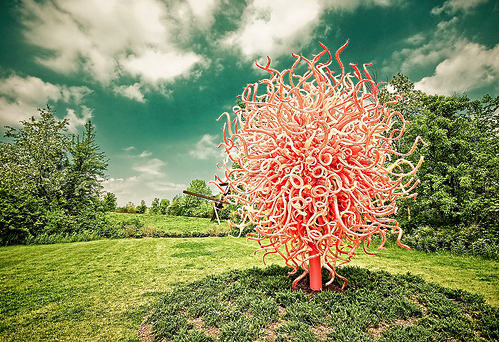
When considering that a lot of my work before the last assessment was influenced by Michael Craig-Marting and stain glass windows I thought I would collect some images to look back on if in need of inspiration for different ways of using glass:
Friday, 24 February 2012
A2AA...
My university is involved in Artists Access to Art Colleges, and as part of this the artists involved had a panel discussion for our course to learn about their practice. One of the artists, Nikki Pugh perticuly interested me due to her what she investigates in her practice. On the A2AA website Pugh describes what she intends to do in this statement: 'I will be using the AA2A scheme to develop and build objects that house landscape- reactive electronic systems in such a way that they also relate to the human body – either through being worn or being carried. Imagine wearing a wooden yoke across your shoulders that collects GPS data as you walk around the city. Imagine a dowsing rod that detects wi-fi networks. We constantly strive to build our computational systems into smaller and lighter forms, but what does it feel like to instead build them into heavy, wooden objects that must be very deliberately transported?'
By recording peoples movement on a daily basis Pugh is making evidence of someone's presence and therefore shows a form of there existence. Whereas I have chosen to show the presence of someone by showing the environment they leave being with a feeling of an absence, Pugh literally shows you the route someone has taken and can pin point where they have been.
When talking about herself she goes on to say: 'I work in the grey areas between and across Art, Science and Technology, instigating enquiry-led processes that are often participatory in nature.
I'm primarily interested in issues around interaction: how we interact with spaces and landscapes; how we interact with each other; and how we interact with objects. Typically I will instigate a starting point and a mechanism to support exploration and criticism.
My practice encompasses locative and digital media, walking, performative actions in public spaces (in turn including pervasive games), installation, physical computing and collaboration. I rarely work in isolation, preferring instead to work in response to a particular location, context or conversation.'
When looking at Nikki Pugh's personal website most relevant projects of Pughs to mine where those relating to the Digbeth area in Birmingham, around the east side of town, which is where I currently live and have situated some of my work in. I found it interesting how she has literally recorded her route around the Eastside using two GPS to show when she had been on her walk. With the Eastside going through drastic redevelopment Pugh's records are perfect for revisiting to see how things have changed. As part of my development I have been going around town and trying to capture scenes that I feel give the same sort of feeling as the most successful image from last time (which I have used repeatedly on my window and on the white boards), by doing so I also have noticed the amount of buildings that have been left or are planed to be renovated. I feel like this fits in to what I'm looking at, instead of people I am capturing these places that we exist in showing it in a moment in time. Like Pugh's GPS records these drawings could be good to look at in a years time or two and see how the scene has changed.
Finally, an interesting discovery that I found on Nikki Pugh's website was a link for the an organisation called Still Walking. They arrange walking tours around Birmingham with different themes, the next one I can join is 'Birmingham Noir' on 15th March, I think it could be beneficial to get to know the city I live in and perhaps descover things about it I never knew before.
By recording peoples movement on a daily basis Pugh is making evidence of someone's presence and therefore shows a form of there existence. Whereas I have chosen to show the presence of someone by showing the environment they leave being with a feeling of an absence, Pugh literally shows you the route someone has taken and can pin point where they have been.
When talking about herself she goes on to say: 'I work in the grey areas between and across Art, Science and Technology, instigating enquiry-led processes that are often participatory in nature.
I'm primarily interested in issues around interaction: how we interact with spaces and landscapes; how we interact with each other; and how we interact with objects. Typically I will instigate a starting point and a mechanism to support exploration and criticism.
My practice encompasses locative and digital media, walking, performative actions in public spaces (in turn including pervasive games), installation, physical computing and collaboration. I rarely work in isolation, preferring instead to work in response to a particular location, context or conversation.'
As my work moves more into site-specific work and interaction from the audience it could be worth while looking further into the work of Pugh to understand how people might react to my work in different location.
When looking at Nikki Pugh's personal website most relevant projects of Pughs to mine where those relating to the Digbeth area in Birmingham, around the east side of town, which is where I currently live and have situated some of my work in. I found it interesting how she has literally recorded her route around the Eastside using two GPS to show when she had been on her walk. With the Eastside going through drastic redevelopment Pugh's records are perfect for revisiting to see how things have changed. As part of my development I have been going around town and trying to capture scenes that I feel give the same sort of feeling as the most successful image from last time (which I have used repeatedly on my window and on the white boards), by doing so I also have noticed the amount of buildings that have been left or are planed to be renovated. I feel like this fits in to what I'm looking at, instead of people I am capturing these places that we exist in showing it in a moment in time. Like Pugh's GPS records these drawings could be good to look at in a years time or two and see how the scene has changed.
Finally, an interesting discovery that I found on Nikki Pugh's website was a link for the an organisation called Still Walking. They arrange walking tours around Birmingham with different themes, the next one I can join is 'Birmingham Noir' on 15th March, I think it could be beneficial to get to know the city I live in and perhaps descover things about it I never knew before.
Thursday, 23 February 2012
Living room window update...
A new response from my accommodation:
In a reaction to the second windows down's 'We see you', the flat above have written 'They can't see us' on theirs with an arrow pointing downwards. It's weird to think how because of my window display two flats have now joined it.
The amusing thing about the top flats comment is how the flat below can't see them, but I want another reaction, which I reckon will happen if the second flat down realise the above flats window, so we've responded with 'we see you both' in the hope that the second flat down will question what that means...
Wednesday, 22 February 2012
Statement of Intent. Individual Practice 3: Development...
Module learning outcomes (on successful completion you will be able to do the following):
Processes/Materials/Workshops (indicate how you intend to develop practical and technical skills in relation to the above):
- Demonstrate an understanding of how to develop meaning and articulate ideas through further creative Explorations of methods, materials, strategies and contexts
- Apply further analytical and critical skills to your own work and that of others in your peer group and in other levels on the course
- Demonstrate a further range of technical and practical skills and investigations
- Demonstrate further creative, research and organisation skills in broadening and managing a strategy for practice
- Needs to be some resolution of the ideas that had emerged last term
- More development of ideas in the video and digital works
- Need to visit more galleries and see more work in situe.
Content of Investigation (description of how the content is to be developed from the last module):
- During my feedback some of the suggestions for possible development were:
- Write letters to uni for permission to put artwork up on their white walls.
- Projections? (Onto studio walls to give the illusion of a space to walk in).
- Get people to interact to change the projection.
- Make things poke out of wall (to make the image 3D or to make an illusion and interrupt it).
- Consider changing the scale of the items in the picture to not be to scale.
Processes/Materials/Workshops (indicate how you intend to develop practical and technical skills in relation to the above):
- Experiment with the use of projectors, where they can be placed (health and safety), to what scale they can be projected and using obstacles for illusions.
- Make my images 3D, so possible look into sculpture and installation.
- Use more photo manipulation to experiment with more images and designs to consider the idea of scale etc.
- Experiment with materials onto acetate/Perspex to create more stain glass ideas
- Test printing onto clear materials for fast production.
- Look into Miwon Kwon for theories on site-specific art.
- Go to related galleries and exhibitions.
- Research site specific art that can be viewed in its environment currently
Tuesday, 14 February 2012
Update on the living room window...
The window opposite our living room have added to their message, now with some text saying 'we see you' as shown below:
Seeing as the window design I made provoked this reaction I wanted to see if we could push them to do something else, make them interact some more, so we replied with this message 'And?' on the same original living room window the image had been created on before:
Let's see what happens...
Monday, 13 February 2012
Miwon Kwon...
A book that I was recommended was 'One Place After Another: Site-Specific Art and Locational Identity' written by Miwon Kwon. I've started by reading the introduction, so the following are some notes from what I've found so far:
Artists mentioned that use site specificity:
- 'Which incorporated the physical conditions of a particular location as integral to the production, presentation and reception of art.' With my stain glass work, the environment the image is displayed in is and the light at different times of the day are crucial in the display, experience and interaction with the work. Therefore making the place it is displayed in part of the work; site specific.
- 'To mark a difference from artistic precedents of site specificity whose dominant positivist formulations (the most well known being Richard Serra's) are deemed to have reached a point of aesthetic and political exhaustion.' Try not to do the obvious with it as, in the opinion of Kwon, it is tried and tested.
- '"urban-aesthetic" or "spatial-cultural" discourse, which combines "ideas about art, architecture, and urban design, on the other hand, with theories of the city, social space, and public space, on the other". Kwon's definition
- 'The definition of site specificity is being reconfigured to imply not the permanence and immobility of work but it's impermanence and transience.' Consider having permanent installation and see how they change? Consider having the same installation that can be transported into other locations or recreated again and again?
- 'The site can no be as various as a billboard, an artistic genre, a disenfranchised community, an institutional framework, a magazine page, a social cause, or a political debate.' Things to consider.
- 'Meant to equalize the creative authority of artists and architects in the design of public spaces, this mode of site specificity presumed the humanizing influence of art over the inhumanity of urban architecture.' Human existence within urban culture/cities like myself.
- 'Thus, in it's final pages, the book can only conjure the critical capacity of intimacies based on absence, distance, and ruptures of time and space.' What I'm looking at... continue to read more in-depth.
- Michael Asher
- Daniel Buren
- Hans Haacke
- Meire Laderman
- Mark Dion
- Andrea Fraser
- Renee Green
- Christian Phillipp Muller
- Fred Wilson
Wednesday, 8 February 2012
Feedback tutorial...
Possible developments for my project:
- Write letters to uni for permission to put artwork up on their white walls.
- Projections? (onto studio walls to give the illusion of a space to walk in).
- Get people to interact to change the projection.
- Make things poke out of wall (to make the image 3D or to make an illusion and interrupt it).
- Consider changing the scale of the items in the picture to not be to scale.
Subscribe to:
Posts (Atom)


.jpg)
.jpg)
.jpg)
.jpg)
.jpg)
.jpg)
.jpg)
.jpg)
.jpg)
.jpg)